Thursday, September 13, 2018

Almost On the Road (Again)

Much of the last several days have been spent sorting through stuff, trying to find things, and making some attempt at identifying what may be needed. While working in the garage, I had the Raspberry Pi DMR hotspot running in the truck tethered to either my cell phone or iPad. Both are on Verizon and share the same "unlimited data". The iPad is not rate limited when tethering as are the phones. The hotspot data requirements are fairly minimal but I should really get some samples.

I installed some reflectors and reflective tape on the hitch mounted cargo carrier since it hangs out quite a ways behind the vehicle. After some thought, I decided to order a light kit for the carrier. This would add tail, brake and turn signals. I may still leave the reflectors and reflective tape installed. I don't plan on having anything on the carrier on our way down the highway or else I would need a license plate bracket and light. The truck license would be blocked by just about anything on the carrier. The trailer license plate is high enough not to be blocked.

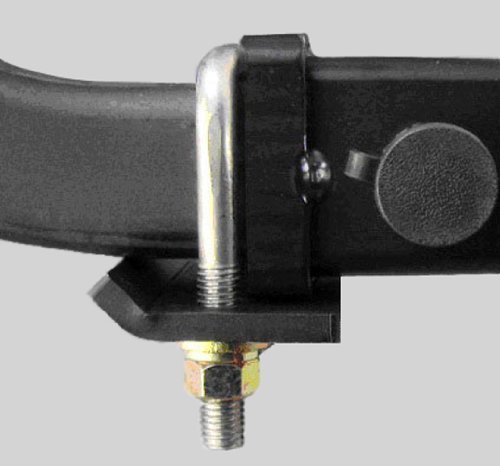
I also ordered an anti-rattle hitch stabilizer. Without this, the cargo carrier does move around a bit with some noise. Especially if it is empty or lightly loaded. The folks at Trailer Craft mentioned that some people just jam wooden shims into the receiver between the hitch and the drawbar. This clamp is simple enough and I won't have to fight when pulling out the drawbar. When installed, there is no more movement or rattle. It works great.

It took some time to sort out the tools again. I've been using them all summer on a variety of projects. Unlike last time, I now have them sorted out in three tool bags. Electrical tools, hand tools, and power driver and drill items. The computer gear increased since the DMR radio requires a Windows PC. I thought about running a VM on the Mac but I would then need to purchase a Windows license.

I partially disassembled the bicycle so it fits more easily under the tonneau cover and takes less space, but between the bicycle, the RV cover and the inflatable raft, there isn't a lot of space left. Fortunately, we don't need to bring down a lot of stuff.

Saturday, September 8, 2018

Denali VIew

On Friday, we drove down to Anchorage. The trip started out cloudy and rainy in Fairbanks but one we passed the Denali Natl Park, the weather improved dramatically. This picture was taken from the south viewpoint just north of Mary’s McKinley View Lodge at mile 134.5 Parks Highway. It was a pretty nice view.  The traffic got pretty heavy as we approached Anchorage. Between the normal rush hour traffic and the ones escaping for the weekend, the line of trucks was almost continuous. I think that the many were hunters out for the now elusive moose as the season just opened at the beginning of the month. This is just a quick weekend trip.This started out as a BlogTouch Pro post but I found a workaround to not using their photo post mechanism. Not being able to “click” on photos is a major shortcoming of the software. Or maybe I haven’t figured it out...


Thursday, September 6, 2018

More Trip Prep

The days are getting shorter and shorter. I just noticed that sunset is before 9pm and the low temperature for Saturday is forecast to be freezing. It looks like it's time to leave the state. At least for a while.

I generally follow the Schedule "B" service intervals on the truck, a 2005 5.9 liter CTD (Cummins turbo diesel). This is recommended for frequent short trips, towing, temperatures below 32°F, or other "severe" use. It looks like I qualify on several counts. This means oil changes at 7,500 miles, oil and fuel filters every 15,000 miles, and coolant every 100,000 miles.

I've been putting the fuel filter replacement task off all summer since it was a real mess the last time I did it myself. This time, no mess at all. I guess I must be learning something. The fuel filter is a cartridge in a clear plastic housing. You first drain the filter housing using the provided water drain valve, then using a 6-pointed socket you remove the plastic top of the housing. The 6-pointed socket is to prevent damage to the plastic "nut" on the top of the housing. The filter is clipped into the bottom of the plastic top. Replace the filter and the "O"-ring which is included with the fuel filter if you get a good filter. Last time, I picked a filter up at the local auto parts store and it didn't clip into the top nor did it include the "O"-ring or the rubber gasket at the bottom of the filter. These had to be scavenged from the old filter. Hence, the mess. This time, I picked up a Fleetguard filter from the local Cummins shop. The whole job was maybe ten minutes. The engine needed to crank for a bit to allow the filter housing to refill. The moral of the story is don't buy filters at the local auto parts store.

The oil change was a simple job. The system holds 12 quarts and I drain the oil directly into gallon jugs for disposal using a 1/4 turn ball valve that I installed back in 2005 at the first oil change. Almost 12 quarts drained out except for maybe 1 cup. Essentially, no oil consumption since the last oil change. The new oil filter is also a Fleetgaurd item that I picked up at the same time as the fuel filter.

I will pick up another fuel and oil filter to have with me on the trip. Back around 1996, I had a filter clog up on my 1991 Ford 7.3 liter diesel just about 2 miles from Watson Lake. I limped into town at about 10 mph, picked up a filter at the local Napa store and replaced it in the mall parking lot. After that, I started carrying spare filters.


Saturday, September 1, 2018

Steep Learning Curve

Since I can't afford to get an HF (High Frequency) radio plus antenna at this point in time, I'm looking into Digital Mobile Radio aka DMR. This mode uses low bandwidth digital transmissions over UHF (Ultra High Frequency) and VHF (Very High Frequency) radio frequencies to a local repeater. The repeater is connected to the Internet and your digitized voice is sent out as an IP data packet. You use globally assigned talk groups to communicate kind of like a digital party line. Anyone who is keyed up on that talk group can communicate with the voice data traversing the Internet.

To use DMR, I needed a radio that has the proper digital capability. Two Chinese companies, Radioddity and Baofeng, worked together to bring out a very affordable tier 2 DMR radio. The RD-5R. The case looks like the very common (and cheap) Baofeng UV-5R but the innards, programming software, and commands are Radioddity. It is dual-band i.e. 2m and 70cm and supports analog in addition to DMR. Right now, I'm just monitoring the Ester Dome analog repeater at 146.880 MHz. One of the challenges for me is that the Radioddity programming software is Windows only. And DMR is too cumbersome to even try and do manually. If that’s even possible.

The other necessary piece is access to a DMR repeater. Unfortunately, there are no DMR repeaters in Fairbanks. In fact, the only one in Alaska appears to be in Homer. UHF frequencies are strictly line of sight so not a chance of reaching more than 20 miles or so. The solution is a hotspot such as a Raspberry Pi with a radio "hat". The Raspberry Pi is a small, cheap single board computer that was developed to teach computer programming skills. It has built-in Ethernet, HDMI video, 4xUSB ports, audio out, and a camera connection. The Pi 3 has built-in WiFi and Bluetooth. Since I only plan on running DMR, I'm using an older Pi 2 and a WiFi USB dongle that I've had lying around. The "hat" is a daughter card which, in this case, has a 70cm radio and is made by DVMEGA. The transmit power is only a tenth of a watt so this is strictly a local device. But local could be in the RV tethered to my phone.

The software image that I'm using is called Pi-Star and the download includes Raspian, the Linux operating system for the Raspberry Pi hardware so all I needed to do was copy the bootable image to a micro SD card and plug that into the Pi. With the DVMEGA hardware, it supports not only DMR but also D-Star and Yaesu System Fusion. These are two other digital modes. DMR seems to be a more open standard i.e. supported by cheaper radios, that's the one I opted to mess around with try. I now have the Raspberry Pi/DVMEGA hotspot running but needed to order a small 70cm antenna for the daughter board. The screenshot on the left is the Pi-Star software running my hotspot. 

DMR is somewhat confusing since it is a commercial system being adapted for amateur radio. It's far from a perfect fit. It took me a couple of days but I think that I finally have the digital part of the radio configuration worked out. On Thursday afternoon, I connected through the hotspot to talk group Tac-310, which is listed as North America, and talked to several guys in MN, CA, AZ and TX. And this was with the hotspot paired with my phone. I had the hotspot sort of working on Tuesday but couldn't hear any audio from the radio. At that point, I wasn't sure if it was the configuration of the radio or the hotspot. It turned out to be one checkbox on the channel config of the radio. There isn't a lot of documentation or information on this stuff except on the Internet. The last picture is the completed hotspot. I found a nice aluminum case on Amazon for only $7 and I just needed to cut a small hole for the antenna.

I haven't tested the range of the hotspot but it's now usable throughout the house. The limitations to the range are the gain of the antenna and the output power of the hotspot radio.

Sunday Afternoon Update - I updated from the Raspberry Pi 2B to the Pi 3B which has built-in WiFi. The CPU load is now about 1/10th of what it was but the metal case was limiting the WiFi range. This isn't really a problem as I'm planning on having this sit right next to the AP anyway. I plugged in the little USB dongle and the link quality jumped up to 100/100 from 40/100. The data needs of this system is pretty low but the reduced load and temperature is significant.